[10 minutes]

Music as an Ancestral Human Ability
Throughout human history, science and music have maintained an intrinsic relationship, marked by mutual influences and a continuous intellectual exchange. Music stands out as a unique human activity due to its universality and antiquity. Archaeological evidence, such as bone flutes over 35,000 years old found in the Danube region, dating back to the Upper Paleolithic, suggests that musical ability emerged very early in human evolution, positioning itself as an ancestral cognitive function (Zatorre and Salimpoor, 2013).

This flute, carved from the radius bone of a vulture, features five finger holes and a notched end for blowing. Fine incisions near the holes likely served as guides for their precise placement. Radiocarbon analysis dates the instrument to over 35,000 years ago, during the Upper Palaeolithic period, highlighting early evidence of musical expression in human history. Source: Adapted from Zatorre and Salimpoor (2013), originally published by Macmillan Publishers (ref. 1, 2009).
As an art form, music organizes sound for aesthetic, ritual, communicative, and emotional functions. Despite huge cultural diversity, there are a number of characteristics commonly shared among societies: structured rhythms that often feature a regular beat capable of inducing movement or dance; melodies produced from scales (sets of pitches and intervals that serve as the basis for musical composition) and repetitive rhythmic patterns that facilitate predictability and collective participation. Although there are exceptions, such as Gregorian chant or the alap section of Indian ragas, which may not have a regular pulse, the presence of rhythmic and melodic structure is a constant in most musical traditions.
Music as a Tool for Social and Emotional Connection
The connection between music and emotion is equally universal. The act of singing to babies, which is common in cultures around the world, demonstrates the early role of music in human development. Lullabies and vocalizations with a soft tone and predictable rhythm help babies regulate their emotional state, maintain attention, and strengthen the caregiver-child bond. Evidence from developmental psychology shows that live, interactive singing supports socioemotional regulation and promotes affective bonding (Lense et al., 2022).
Anthropological perspectives reinforce this interpretation. A large-scale cross-cultural study conducted by Mehr et al. (2019), analyzing ethnographic records and audio recordings from diverse societies, revealed that vocal music is present in all cultures examined. Although musical forms vary widely, certain social contexts, such as childcare, healing practices, dance, and expressions of affection – are consistently associated with musical production. These patterns suggest that music is not just an arbitrary cultural creation, but a deeply rooted form of human behavior, closely linked to social, emotional, and communicative life.
The Evolution of Music: From Darwin’s Theories to Modern Perspectives
Among the various theories that exist about the purpose of the evolution of music is Darwin’s, who argued that music exists today because our ancestors were musical. Darwin linked this ancestral musicality to the role that music plays in the lives of birds, with the purpose of attracting mates, mating, and defending territory. Therefore, the question remained whether our ancestors also used songs, before speech, to attract mates. His theory is just one among many, and most modern theories have moved away from this type of explanation based on attracting mates and proposed functions at the group level, such as music having some functional value for groups of individuals. Or in the way it brings people together and puts them in an identical and safe emotional state. However, both theories align with contemporary neuroscience, which demonstrates the involvement of music in emotional, social, and cognitive systems essential to human beings, both individually and in groups. (Zatorre and Salimpoor, 2013).
Civilizations That Shaped the Science of Sound
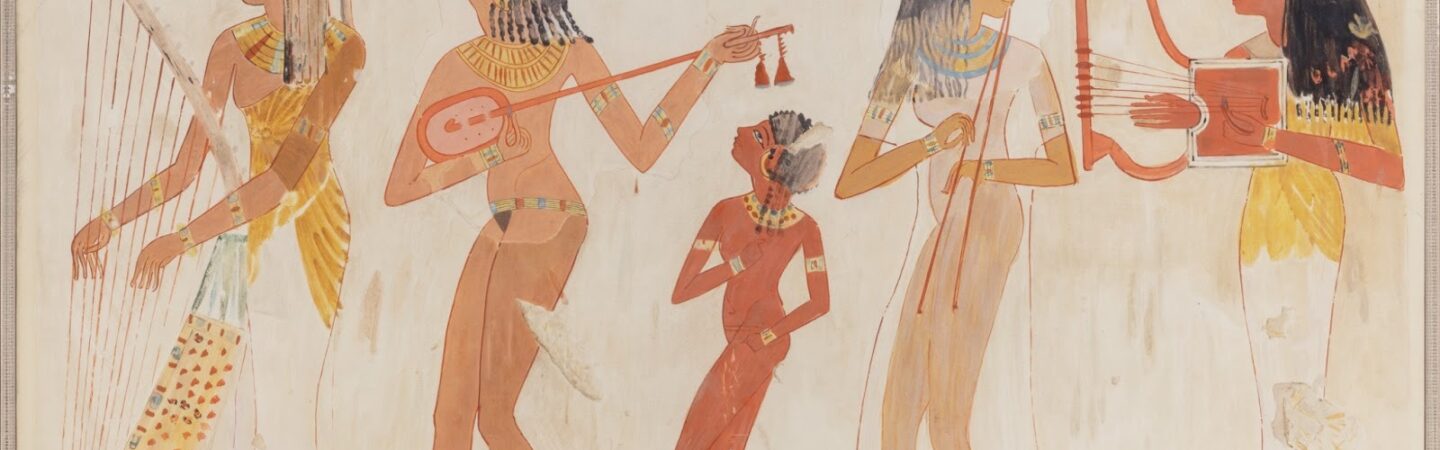
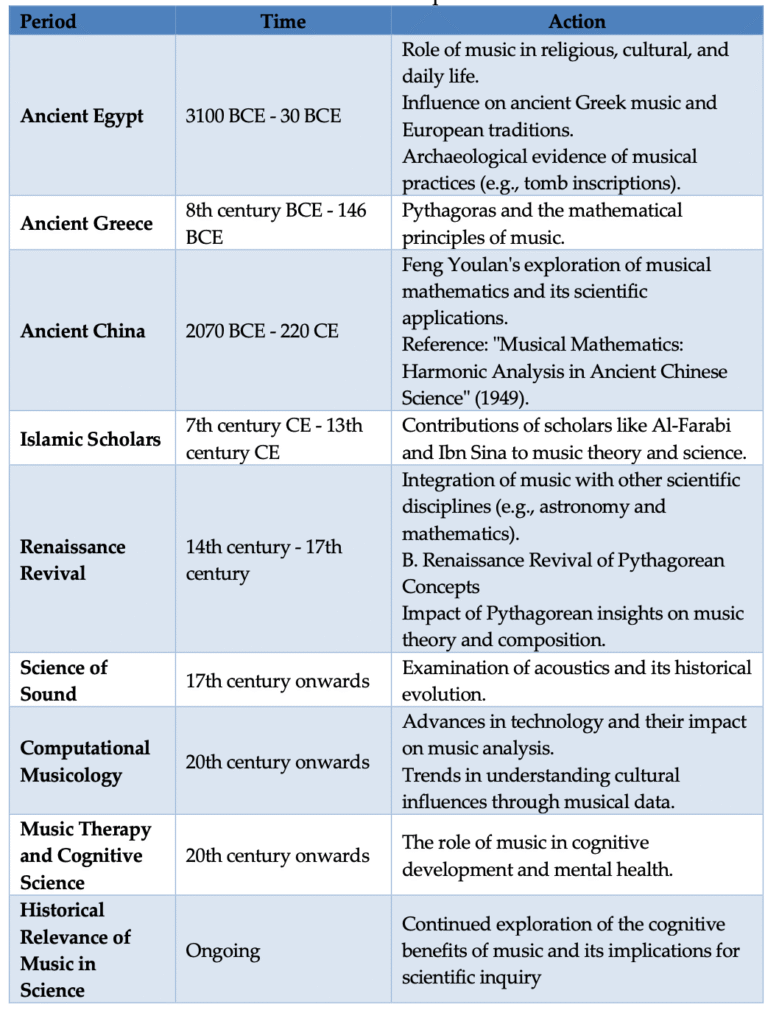
Since ancient Egypt, where music played a vital role in religious, social, and healing practices, and where early acoustic knowledge influenced the construction of temples and instruments, music has been integrated into scientific thought. In Ancient Greece, Pythagoras discovered the mathematical relationships of musical intervals and laid the foundations for music theory. Pythagorean knowledge of the mathematical proportions of musical intervals and the harmony of the spheres shaped Greek philosophy and science. Later, advances in the understanding of sound propagation and architectural acoustics were made by the Romans, who explored the acoustics of amphitheaters, and by scholars such as Al-Farabi and Ibn Sina during the Islamic Golden Age, who explored the relationship between science, mathematics, and music, playing a vital role in Islamic culture and influencing scientific disciplines such as astronomy and optics (Ead, 2024).
From Mathematics to Art: The Turn of the Modern Era
In the 17th and 18th centuries, music was still considered a kind of arithmetic, a perspective rooted in Pythagoras’ original perception that string vibrations produce mathematical intervals. The shift in this view, and the reconsideration of music as art, began in the 17th century, when scientists reevaluated their views on science in general after Galileo’s discovery of the laws of planetary motion (Ead, 2024).
As these historical conceptions of music and science evolved over the centuries, the relationship between the two remained present in modern scientific advancement. This historical perspective is reflected in the way music has accompanied scientific creativity throughout the ages. Several Nobel Prize winners – including Albert Einstein- reported that music stimulated creative thinking and contributed to the development of scientific theories. This relationship persists in contemporary examples of scientists who explicitly integrate music into their work, as summarized by Ead (2024): figures such as Alexander Graham Bell, Carl Sagan, Daniel Levitin, and contemporary researchers in music cognition use music as an experimental tool, an object of research, or a means of communicating complex ideas. Together, these examples illustrate how scientific research and musical practice continue to inform and drive each other forward.
Table 1. Historical evolution of the relationship between music and science.
The Modern Convergence of Music and Science
In recent decades, the scientific study of music has expanded its reach across multiple disciplines. In acoustics, research has shed light on how sound waves behave and how musical instruments work and in neuroscience, growing evidence has revealed how the brain perceives, processes, and responds to musical structures.
Scientific research shows that learning and practicing music is associated with measurable changes in brain structure and function. Neuroimaging studies demonstrate that musical training can lead to adaptations in auditory, motor, and multimodal integration areas, including changes in white matter pathways and connections between the two hemispheres (with some of these changes emerging after relatively short periods of training). For these reasons, music has become a valuable model for studying how the brain learns and adapts throughout life, although the extent and nature of these effects vary according to factors such as age of onset, intensity of training, and individual predispositions (Herholz & Zatorre, 2012).
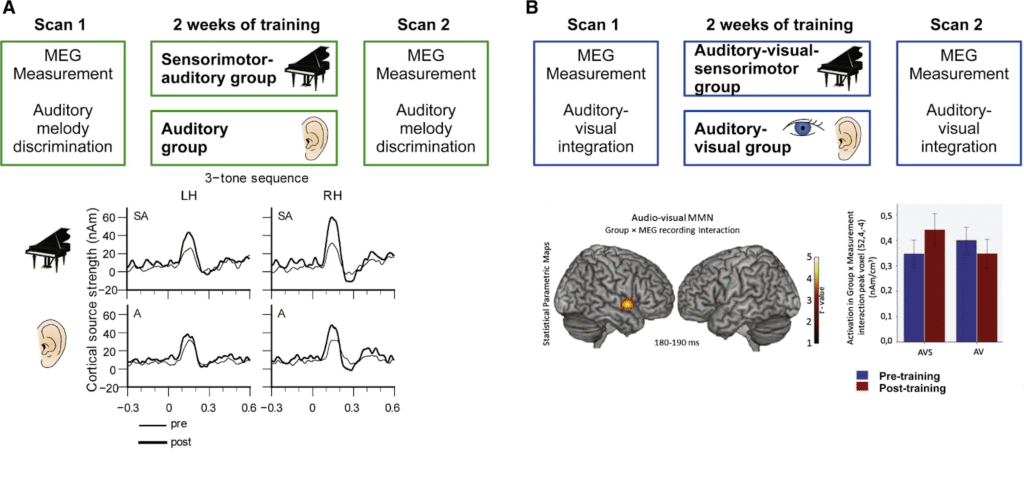
The left panel illustrates that piano training combining auditory and motor components leads to a greater enhancement of auditory mismatch negativity responses to unexpected tones than purely auditory training after two weeks. The right panel shows that learning short piano melodies through combined auditory, visual, and motor engagement produces stronger neural responses to audio-visual mismatches than audio-visual training without active motor involvement. Adapted from Lappe et al. (2008) and Paraskevopoulos et al. (2012), as reviewed in Herholz & Zatorre (2012).
In clinical settings, music therapy has developed a solid and growing evidence base, with applications ranging from pain and anxiety reduction to motor and cognitive rehabilitation. Developmental psychology also highlights the cognitive, emotional, and social benefits of lifelong musical engagement.
Together, these lines of research have contributed to consolidating the field of music neuroaesthetics, which examines how musical structure, expectations, personal memories, and listening context interact to create aesthetic responses – from the perception of beauty and emotional tension to pleasure and a sense of meaning. This field emphasizes that music should not be viewed just as a cognitive process, but as a complex artistic and emotional experience (Brattico & Pearce, 2013).
Recent advances in neurotechnology have taken musical brain-computer interfaces far beyond their initial experimental phase. With lighter EEG devices and real-time processing systems, it has become possible to create musical environments that not only reflect brain activity but respond to it as it changes. Rather than simply translating EEG signals into sound, contemporary systems create adaptive feedback loops in which the brain and music continuously influence each other.
This bidirectional relationship, observed in emerging adaptive sound engines and modern neurofeedback-based platforms, opens up space for deep personalized experiences, therapeutic possibilities, and new forms of artistic expression. Recent systematic reviews highlight that music can function as a meaningful and effective feedback modality within these systems, supporting processes of neural self-regulation and modulation of internal states (Ehrlich, S.K. et al., 2019).
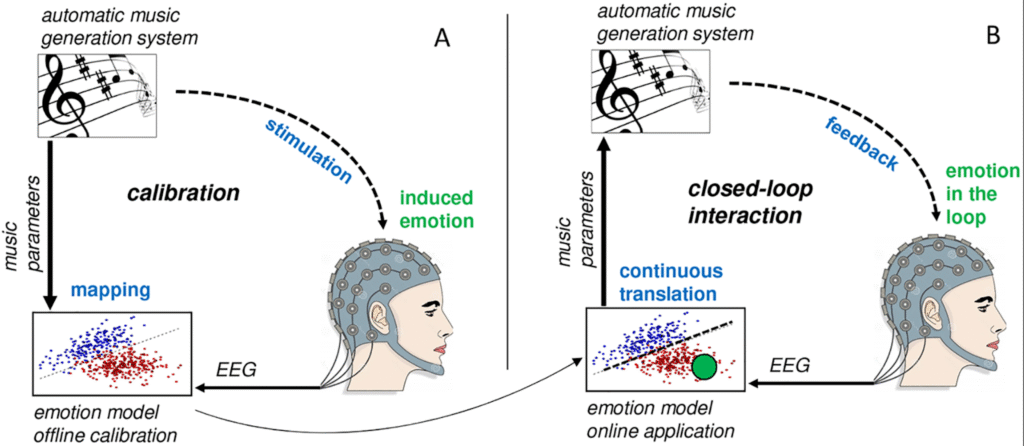
Conceptual overview of an affective music BCI system. During an initial calibration phase, EEG signals are used to build an individual emotion model based on responses to automatically generated music. During online operation, this model enables continuous translation of brain activity into adaptive musical output, creating a closed feedback loop in which music and neural states dynamically influence each other. Adapted from Ehrlich et al. (2019).
Through these technologies, music becomes a medium capable of sensing, interpreting, and gently shaping internal states, deepening our understanding of how humans and sound co-regulate each other. The relationship between science and music is therefore historical and continuously evolving, inspiring and informing each other and offering valuable insights into the human experience, uniting reason and emotion, order and expression, knowledge and art.
REFERENCES
Brattico, E. & Pearce, M. (2013) ‘The neuroaesthetics of music’, Psychology of Aesthetics, Creativity, and the Arts, 7(1), pp. 48–61. doi:10.1037/a0031624. Available at: https://www.researchgate.net/publication/255485956_The_Neuroaesthetics_of_Music
Ead, H.A. (2024) ‘Exploring the Intersection of Science and Music through Ancient Civilizations to the Present’, Athens Journal of History, 10, pp. 1–22. Available at: https://www.athensjournals.gr/history/2024-5856-AJHIS-Ead-02.pdf
Ehrlich, S.K. et al. (2019) ‘A closed-loop, music-based brain–computer interface for emotion mediation’, PLOS ONE, 14(3), e0213516. doi:10.1371/journal.pone.0213516. Available at: https://journals.plos.org/plosone/article?id=10.1371/journal.pone.0213516
Lense, M.D. et al. (2022) ‘Music of infant-directed singing entrains infants’ social visual behavior’, PNAS. Available at: https://doi.org/10.1073/pnas.2116967119
Mehr, S.A. et al. (2019) ‘Universality and diversity in human song’, Science, 366(6468), eaax0868. doi:10.1126/science.aax0868. Available at: https://pubmed.ncbi.nlm.nih.gov/31753969/
Zatorre, R.J. & Salimpoor, V.N. (2013) ‘From perception to pleasure: Music and its neural substrates’, Proceedings of the National Academy of Sciences of the United States of America, 110(Supplement 2), pp. 10430–10437. Available at: https://www.pnas.org/doi/epdf/10.1073/pnas.1301228110
Herholz, S.C. & Zatorre, R.J. (2012) ‘Musical training as a framework for brain plasticity: behavior, function, and structure’, Neuron, 76(3), pp. 486–502. doi:10.1016/j.neuron.2012.10.011. Available at: https://pubmed.ncbi.nlm.nih.gov/23141061/
